
Introduction: Why AI Became Essential for SEO in 2026
If you’ve been keeping an eye on the digital marketing world lately, you’ve probably noticed something remarkable: search engines have become almost eerily good at understanding what people actually mean when they type a query. That’s not magic — that’s artificial intelligence working behind the scenes, and it’s completely reshaping how we think about SEO.
In 2026, Google’s algorithms have evolved far beyond simple keyword matching. Thanks to systems like Google MUM (Multitask Unified Model) and Gemini-powered search features, the engine now processes text, images, video, and audio simultaneously to deliver answers that feel genuinely helpful. Zero-click searches — where users get their answer directly on the results page without clicking through — now account for a significant share of all searches. AI Overviews (formerly known as Search Generative Experience) appear at the top of many results, summarizing information before a single blue link is shown.
This shift puts enormous pressure on content creators and businesses. Traditional SEO tactics — stuffing keywords, building low-quality backlinks, or publishing thin content — no longer cut it. What works today is a smarter, more strategic approach: one where AI tools help marketers research faster, write better, audit more thoroughly, and predict trends before they peak.
The good news? AI isn’t replacing SEO professionals. It’s empowering them. In this guide, we’ll walk through every major area where AI SEO optimization is making a real difference in 2026 — from keyword research and content generation to technical audits and predictive analytics. Let’s dive in.
AI SEO Tools Are Transforming Digital Marketing
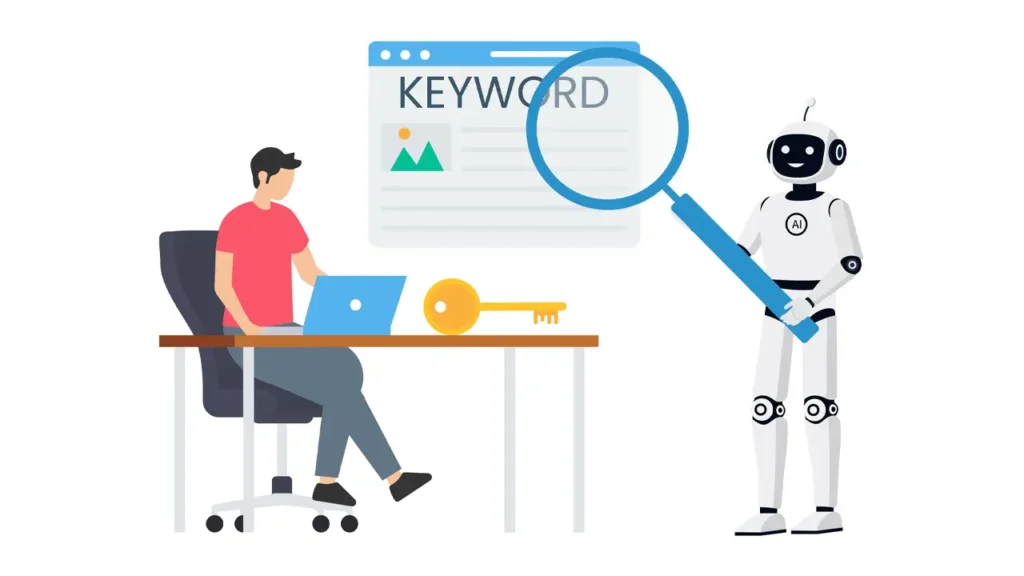
Not too long ago, doing serious SEO work meant hours of manual research, spreadsheet juggling, and guesswork. Today, AI SEO tools have compressed that timeline dramatically, allowing even small teams to compete with enterprise-level operations.
Platforms like Surfer SEO use natural language processing to analyze the top-ranking pages for any given keyword and produce detailed content briefs — including recommended word counts, heading structures, and semantic terms to include. Semrush’s AI-powered features now offer automated competitive gap analysis, suggesting exactly which topics a site is missing compared to its rivals. Jasper and similar writing assistants help marketers draft content frameworks in minutes, while tools like Clearscope score content in real time as you write, flagging missing semantic concepts before you hit publish.
Even Google’s own ecosystem has leaned into AI. Google Search Console now surfaces AI-generated recommendations for improving page performance, and Google Analytics 4 includes predictive metrics powered by machine learning — like the probability that a user will make a purchase in the next seven days.
What makes these tools so powerful is their ability to process enormous volumes of data simultaneously. A human analyst might review 20 competitor pages in an afternoon. An AI tool can review thousands in seconds, identifying patterns that would be invisible to the naked eye.
Here’s a quick comparison of some leading AI SEO platforms in 2026:
| Tool | Primary Function | AI Feature Highlight |
|---|---|---|
| Surfer SEO | Content optimization | Real-time NLP content scoring |
| Semrush AI | Competitive research | Automated gap analysis & topic clusters |
| Ahrefs | Backlink & keyword research | AI-powered keyword difficulty scoring |
| Jasper | Content generation | SEO-aware long-form writing assistant |
| Clearscope | Content grading | Semantic term recommendations in real time |
| Google Search Console | Performance monitoring | AI-generated optimization recommendations |
The takeaway here is that AI tools aren’t replacing the SEO strategist’s brain — they’re removing the tedious groundwork so that strategists can focus on creativity, judgment, and high-level planning.
SEO Content Generation With Artificial Intelligence
Content has always been at the heart of SEO, but the way content gets created has fundamentally changed. SEO content generation powered by AI now covers an impressive range of formats and use cases.
Blog articles are perhaps the most common application. AI tools can generate full draft articles based on a keyword brief, outline, and target audience description. These drafts typically include proper heading structures, natural keyword placement, and relevant subtopics — saving writers hours of initial research and outlining.
Product descriptions for e-commerce sites are another area where AI shines. Platforms with thousands of SKUs can use AI to generate unique, benefit-focused descriptions for every product, something that would take a human team months to accomplish manually.
FAQ blocks have become especially valuable in 2026 because Google’s AI Overviews frequently pull answers from well-structured FAQ content. AI tools can analyze “People Also Ask” data and generate FAQ sections that directly address what searchers want to know.
Multilingual content is now more accessible than ever. AI translation and localization tools produce content in dozens of languages while preserving SEO structure, helping businesses expand into international markets without proportionally expanding their content teams.
Semantic optimization is where AI content generation gets particularly sophisticated. Rather than just repeating a target keyword, modern AI tools ensure that content covers the full semantic field around a topic — related concepts, entities, synonyms, and contextually relevant phrases that signal topical depth to Google.
That said, there’s one thing AI-generated content cannot fully replace: authentic human expertise. Google’s E-E-A-T framework (Experience, Expertise, Authoritativeness, and Trustworthiness) rewards content that demonstrates real-world knowledge and first-hand experience. AI can draft a strong framework, but human editors need to enrich it with case studies, personal insights, original data, and authoritative citations. Think of AI as a very fast, very capable research assistant — one that still needs a knowledgeable editor to sign off before anything goes live.

AndreevWebStudio.com
Professional web development and design services. Custom WordPress sites, landing pages, e-commerce solutions, and 3D printing content creation for businesses and creators.
- • WordPress Development
- • Custom Web Design
- • E-Commerce Solutions
- • 3D Printing Content
AI Keyword Research and Search Intent Analysis
Keyword research used to mean plugging terms into a tool and looking at monthly search volume. In 2026, AI keyword research goes several layers deeper, with a strong focus on understanding why people search — not just what they search for.
AI-powered tools now classify every keyword by search intent: informational (the user wants to learn), navigational (the user is looking for a specific site), commercial (the user is comparing options), or transactional (the user is ready to buy). Understanding this distinction is critical because a page optimized for transactional intent won’t rank well if the searchers for that keyword are actually at the informational stage.
Long-tail keywords have become even more important as AI search generates more specific queries. Instead of searching “SEO tools,” users now ask things like “what AI tool helps me find keyword gaps for a small e-commerce store.” AI keyword research platforms identify these long-tail opportunities by analyzing search query data at scale, finding clusters of specific questions that represent real, underserved demand.
Conversational queries have exploded thanks to the widespread adoption of voice assistants and AI chatbots integrated into search. People talk to their devices the way they’d talk to a person, and keyword research tools have adapted to capture this natural-language search behavior.
Voice search opportunities represent a significant frontier. Voice queries tend to be longer, more question-based, and more locally oriented. AI tools now flag keywords that are particularly strong candidates for voice search optimization, helping businesses capture this growing segment.
Google Keyword Planner remains a foundational data source in all of this — it’s the most direct window into actual Google search volume data. The best AI keyword research workflows pull from Google Keyword Planner as their baseline and then layer on AI-powered analysis to enrich, cluster, and prioritize the data.
Keyword Clustering and Semantic SEO
Here’s something that separates modern SEO from the old way of doing things: instead of targeting one keyword per page and hoping for the best, today’s best-performing sites are built around topical authority — the idea that covering a subject comprehensively across multiple interconnected pages signals genuine expertise to Google.
This is where keyword clustering and semantic SEO come together beautifully.
Keyword clustering is the process of grouping related keywords by shared intent and meaning, so that each cluster can be addressed by a single, well-optimized page rather than creating multiple thin pages that compete with each other. For example, keywords like “AI keyword research,” “AI keyword tool,” and “best AI for keyword analysis” all share the same intent — they should be addressed together on one strong page rather than spread across three weak ones.
AI tools automate this clustering process at scale. They analyze thousands of keywords, identify semantic relationships between them, and group them into logical clusters — a task that would take a human analyst days to do manually.
Semantic SEO builds on this by ensuring that each piece of content covers not just the primary keyword but the full conceptual territory around it. Google’s algorithms understand entities (real-world concepts, people, places, and things) and their relationships to each other. Content that discusses a topic in depth — using related terms, answering related questions, and referencing relevant entities — signals to Google that it’s a genuinely authoritative resource.
A practical example: if you’re writing about “AI SEO optimization,” semantically rich content would naturally include references to machine learning, natural language processing, Google’s ranking algorithms, content quality signals, and specific tools. AI content optimization platforms scan your draft in real time and flag semantic gaps — terms and concepts that high-ranking competitors include but your page is missing.
The result of effective keyword clustering and semantic SEO is a content structure where pages reinforce each other through strong internal linking, creating what SEO professionals call a topic cluster model — a hub page on a broad topic surrounded by supporting pages on specific subtopics, all linked together.
Automated Meta Titles and Descriptions
Meta titles and descriptions might seem like a small detail, but they have an outsized impact on click-through rates — and click-through rate is a signal that influences rankings. Getting these right at scale is where automated meta descriptions and AI-generated metadata deliver real value.
Manually writing compelling meta titles and descriptions for hundreds or thousands of pages is tedious and time-consuming. AI tools now handle this automatically by analyzing page content, identifying the primary keyword and key benefit, and generating multiple variants for human review.
What makes AI-generated metadata particularly effective is its ability to optimize for CTR (click-through rate) — not just keyword inclusion. The best AI tools analyze which meta formats tend to generate more clicks in a given niche and apply those patterns: power words, numbers, questions, emotional triggers, and clear value propositions.
Here’s a breakdown of what AI now helps automate in the metadata space:
| Metadata Element | AI Automation Capability | SEO Benefit |
|---|---|---|
| Meta Title | Generates keyword-rich, character-limited titles | Improves rankings and SERP visibility |
| Meta Description | Creates persuasive summaries with CTR triggers | Increases click-through rate |
| Schema Markup | Suggests and generates structured data code | Enables rich snippets in search results |
| Open Graph Tags | Generates social sharing metadata | Improves social media CTR |
| Alt Text | Auto-generates descriptive image alt attributes | Boosts image search visibility & accessibility |
Schema markup suggestions are a particularly exciting development. AI tools can analyze a page and recommend the appropriate schema type — Article, Product, FAQ, HowTo, LocalBusiness — and even generate the JSON-LD code to implement it. Proper schema implementation increases the likelihood of appearing as a rich result in Google Search, which dramatically improves visibility and click-through rates.
SEO Audit Automation for Faster Optimization
Technical SEO has always been important, but auditing a large website for technical issues used to require significant time, specialized knowledge, and expensive tools. SEO audit automation powered by AI has changed that equation entirely.
Modern AI-driven audit tools can crawl an entire website, analyze every page, and produce a prioritized action plan — all within hours. Here’s what they’re looking for:
Broken links — both internal links pointing to deleted or moved pages and external links going to 404 errors — are automatically detected and listed with their source pages, making cleanup straightforward.
Core Web Vitals issues are flagged automatically. Google’s Core Web Vitals (Largest Contentful Paint, Interaction to Next Paint, and Cumulative Layout Shift) are key ranking factors, and AI audit tools now benchmark your site against Google’s thresholds and suggest specific fixes — whether it’s compressing images, eliminating render-blocking scripts, or improving server response time.
Duplicate content is identified and categorized. The tool distinguishes between truly duplicate pages, near-duplicate content, and canonical tag issues — each of which requires a different fix.
Indexing errors surface quickly. AI tools cross-reference your sitemap with Google’s index (via Search Console integration) to identify pages that should be indexed but aren’t, or pages that are indexed but shouldn’t be.
Mobile optimization problems are caught before they hurt rankings. With Google’s mobile-first indexing firmly established, ensuring that every page renders correctly on small screens is non-negotiable — and AI audit tools check this automatically.
The integration with Google Search Console is particularly powerful. By pulling performance data directly from Search Console — impressions, clicks, average position, Core Web Vitals field data — AI audit tools can correlate technical issues with actual ranking and traffic impact, helping teams prioritize fixes based on real business value rather than theoretical severity.
Predictive SEO and Google Search Trends
One of the most exciting frontiers in AI SEO optimization is the ability to look ahead — to anticipate what people will be searching for before those searches become mainstream. This is the domain of predictive SEO.
Traditional SEO is reactive: you identify keywords people are already searching for and optimize for them. Predictive SEO flips that model. Using machine learning trained on historical search data, social media signals, news cycles, and seasonal patterns, AI tools can forecast which topics and keywords are likely to trend in the coming weeks or months.
Seasonal traffic spikes are one of the clearest use cases. If you run an e-commerce site selling outdoor gear, AI predictive tools can tell you — based on years of historical data — exactly when searches for specific products start climbing, so you can publish and optimize content weeks before the peak, rather than scrambling to catch up after it arrives.
Trending search topics can be identified early by monitoring signals that typically precede search volume growth: rising mentions on social platforms, increasing news coverage, early adoption in specific geographic markets. AI tools synthesize these signals to surface topics that are gaining momentum before they show up strongly in traditional keyword tools.
Future keyword demand forecasting helps content teams plan their editorial calendars strategically. Rather than guessing what to write about next month, AI-powered predictive models suggest content topics ranked by their projected search volume growth — essentially a content roadmap driven by data.
Emerging niches are identified by spotting clusters of new, low-competition queries that are growing rapidly — often around new technologies, cultural trends, or regulatory changes. Getting into these niches early, before competition intensifies, is one of the highest-leverage moves in SEO.
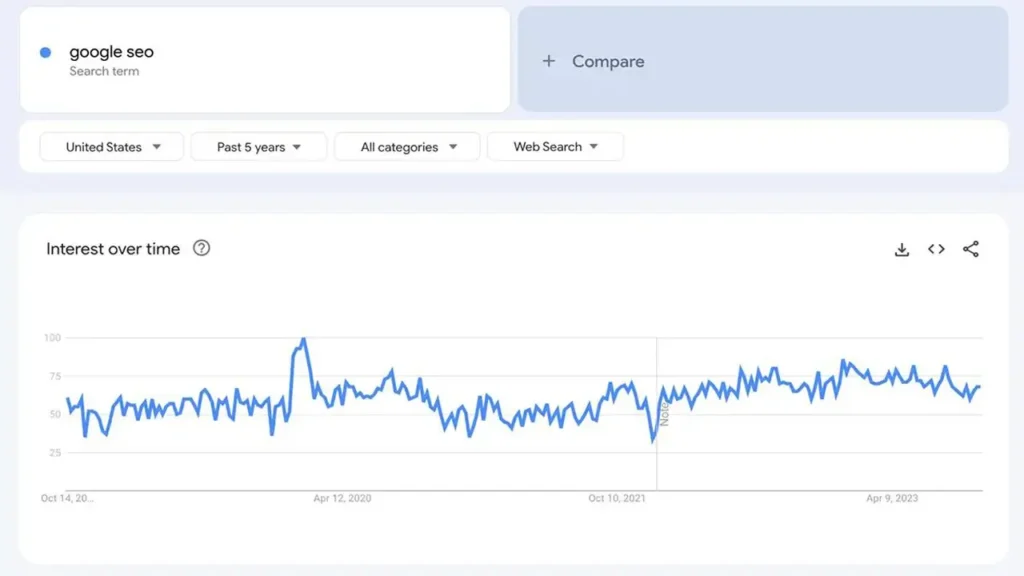
Google Trends remains a valuable foundational tool for understanding search interest over time and by geography. AI-powered platforms build on Google Trends data by adding predictive modeling layers, transforming raw trend signals into actionable content strategies.
Risks of Overusing AI in SEO
With all this talk about AI’s capabilities, it’s important to be clear-eyed about its limitations and risks. The enthusiasm around AI SEO tools is warranted — but overreliance creates real problems.
Low-quality AI content is perhaps the most pervasive risk. When AI generation is set to “maximum output” without meaningful human oversight, the result is often technically correct but genuinely uninspiring content — generic, surface-level, and devoid of the originality and insight that earns both reader trust and editorial links. Google’s helpful content systems are specifically designed to demote this kind of material.
Duplicate content risks increase when multiple sites use similar AI tools with similar prompts to generate content on the same topics. The outputs can be uncomfortably similar — not identical enough to trigger a copyright claim, but similar enough to be indistinguishable from a quality standpoint. When thousands of pages on the web say essentially the same thing in the same way, none of them stand out.
Keyword stuffing has made a quiet comeback in some AI-generated content. Some less sophisticated AI writing tools, when instructed to “include this keyword frequently,” produce content that repeats the target phrase unnaturally — a practice that Google’s algorithms penalize.
Lack of originality is a structural limitation of AI systems trained on existing content. They’re very good at recombining and rephrasing what already exists, but genuine originality — novel research, unique case studies, fresh perspectives born from real experience — still requires human beings.
The bottom line is this: AI is an extraordinarily powerful tool in the SEO toolkit, but it needs skilled human professionals to guide it, review its outputs, and add the layer of genuine expertise and creativity that separates good content from great content. The businesses that will win in SEO in 2026 are those that find the right balance — using AI to handle the heavy lifting while keeping human intelligence firmly in charge of strategy and quality control.
Conclusion: The Future of AI SEO Optimization
We’ve covered a lot of ground in this guide, and the picture that emerges is one of genuine transformation. AI SEO optimization in 2026 isn’t a buzzword or a distant promise — it’s the current reality for any business that wants to compete seriously in search.
The advantages are concrete and measurable. Businesses embracing AI-driven SEO achieve faster rankings because they can publish well-optimized content more quickly and identify technical issues before they become ranking liabilities. They benefit from lower content costs because AI handles much of the research, outlining, and drafting work that used to require large writing teams. They gain better search visibility because AI tools ensure content is semantically rich, technically sound, and aligned with current search intent. And they build a stronger competitive advantage because they’re always a step ahead — anticipating trends, optimizing proactively, and making data-informed decisions rather than educated guesses.
But technology alone isn’t the answer. The most effective AI SEO strategies combine the processing power of modern AI tools with the strategic thinking, creative judgment, and domain expertise of skilled professionals. Whether you’re managing your own site or working with a specialist team, the right approach is one where AI amplifies human capability rather than replacing it.
If you’re ready to take your site’s SEO to the next level — with a strategy built on both technical excellence and creative quality — now is the perfect time to explore what a professional approach to AI-powered SEO can do for your business.
🇬🇧 “Excellent article about AI SEO trends in 2026! Very clear explanations and professional insights. The website design is modern, fast, and easy to navigate. I discovered many useful SEO strategies for my business. Highly recommend visiting www.andreevwebstudio.com for professional SEO and website services.”
🇪🇸 “¡Excelente artículo sobre SEO con inteligencia artificial! El contenido es moderno, útil y fácil de entender. El sitio web se ve muy profesional y rápido. Encontré muchas ideas valiosas para mejorar mi negocio online. Recomiendo visitar www.andreevwebstudio.com.”
🇸🇦 “مقال رائع جداً عن تحسين محركات البحث باستخدام الذكاء الاصطناعي في 2026. المعلومات احترافية وسهلة الفهم، وتصميم الموقع عصري وسريع. تعلمت استراتيجيات SEO مفيدة جداً لعملي. أنصح بزيارة www.andreevwebstudio.com.”
🇨🇳 “这篇关于2026年AI SEO优化的文章非常专业,内容清晰易懂。网站设计现代、速度快、用户体验很好。我学到了很多关于关键词和SEO自动化的新知识。推荐访问 www.andreevwebstudio.com。”
🇫🇷 “Très bon article sur le SEO et l’intelligence artificielle en 2026. Les explications sont modernes, utiles et professionnelles. Le site est rapide et très bien conçu. Je recommande fortement de visiter www.andreevwebstudio.com pour des services SEO.”
🇩🇪 “Fantastischer Artikel über AI SEO Optimization im Jahr 2026! Moderne Inhalte, professionelle Tipps und ein sehr schönes Webdesign. Die Seite lädt schnell und bietet viele nützliche Informationen für Unternehmen. Besuchen Sie unbedingt www.andreevwebstudio.com.”