
Let’s be honest about where we are in 2026. Publishing a steady stream of blog posts used to be a respectable growth plan. Today it’s closer to shouting into a very crowded room. Search engines have changed how they read, judge and surface content, and a pile of loosely related articles, no matter how well written, rarely adds up to real traffic anymore. Algorithms now reward sites that are organized, fast, and clearly expert in a defined area. The sites that win are the ones that look like a library, not a junk drawer.
That shift is exactly why we stopped treating content as the starting point and started treating structure as the starting point. In our own projects, the single biggest lever turned out to be Topic-Cluster Architecture: a deliberate way of grouping content into themed hubs so that both readers and crawlers instantly understand what your site is about and why it deserves to rank. In this article I’ll walk through how we applied it, what we built, what we got wrong along the way, and how you can copy the approach if you’re a startup founder, a media owner, or the person behind a SaaS blog.
The Case Study: AI Innovation Hub and AutoChina.Blog
Theory is cheap, so let’s start with what actually happened. We launched two informational projects from zero: AI Innovation Hub, a resource covering artificial intelligence tools, models and industry shifts, and AutoChina.Blog, a publication about Chinese automotive brands, electric vehicles and the fast-moving market around them.
Neither site had a domain history. Neither had a backlink profile worth mentioning. Both entered niches where established media brands, big tech publishers and well-funded review sites had been publishing for years. On paper, this was a bad fight to pick.
Yet within the first few months, more than 80 pieces of content across the two projects were indexed and competing in organic search. Not every article hit page one, and I won’t pretend otherwise. But the pattern was consistent: new pages got discovered quickly, indexed reliably, and started collecting impressions far sooner than we’d experienced on older, less structured builds.
What made the difference wasn’t a secret trick. It was a sequence of boring, disciplined decisions made before we wrote a single article:
- We mapped the entire subject territory first, then wrote.
- We designed the site structure in a prototype, not after the fact.
- We chose a lean technical stack and protected its performance.
- We marked up content so machines could read it without guessing.
- We published in clusters, not in random bursts.
Each of these deserves its own section, so let’s go one at a time.
Planning Before Pixels: Why Structure Comes First
Most people launch a site the way they’d move into an apartment: they carry in boxes and figure out where things go later. With a content project, that approach quietly creates problems that take months to fix. Pages end up competing with each other for the same queries. Important articles get buried four clicks deep. Categories overlap. Nobody remembers why a tag exists.
Good Website SEO Architecture solves this up front. It’s the plan that decides which topics deserve their own hub, how pages connect, what the URL logic looks like, and how authority flows from one page to the next. If you do this work early, every article you publish afterward slots into a place that already makes sense. If you skip it, you’ll spend your second year untangling your first.
Why SEO for Startups Is a Different Game
Established publishers can survive sloppy structure because they have authority to burn. Startups can’t. SEO for Startups means working with a handful of disadvantages: no trust history, little or no link equity, a small budget, and a limited window before you run out of patience or runway.
That sounds grim, but it also clarifies the strategy. A young site cannot win by being bigger. It has to win by being clearer. Clearer topical focus, clearer internal linking, cleaner code, faster pages, more precise answers. Every one of those advantages is within a startup’s control, and none of them require a decade of domain age.
There’s another upside people overlook: a new site has no legacy mess. You get to build the architecture correctly on day one, while competitors are stuck maintaining five generations of inconsistent decisions.

AI and Web Development
Cutting-edge web development powered by artificial intelligence. Smart automation, AI-driven content, chatbots, and intelligent features to enhance user experience and boost conversion rates.
- • AI-Powered Automation
- • Smart Chatbots & Assistants
- • AI Content Generation
- • Data-Driven Optimization
How to Launch a Content Project Without Creating Chaos
If you’re wondering how to launch a content project in a way that doesn’t collapse under its own weight, here’s the sequence we follow now:
- Define the territory. Write down every subject your site should be known for. Be ruthless. Ten focused themes beat fifty vague ones.
- Research real demand. For each theme, map the questions, comparisons, how-tos and definitions people actually search for.
- Group by intent. Separate broad, high-level queries from specific, long-tail ones. This becomes your hub-and-spoke blueprint.
- Prototype the structure. Sketch the navigation, category pages and article templates before building anything.
- Build the technical foundation. Fast hosting, clean theme, minimal plugins, correct markup.
- Publish in waves. Release related articles together so hubs feel complete from the start.
- Measure, then expand. Add new clusters only after the first ones show traction.
Notice that writing doesn’t appear until step six. That surprises people, but it’s the reason the process works. Content is the fuel; structure is the engine. You don’t pour fuel into a car that has no engine and expect it to move.
Architecture and SEO in the Figma Phase
Here’s a habit that changed our results: we plan architecture and SEO together, inside the design prototype, rather than treating them as separate departments that meet at launch.
When we build screens in Figma, we’re not only deciding colors and typography. We’re deciding where hub pages live in the main menu, how breadcrumbs behave, which blocks on an article page link to related content, and how many clicks it takes to reach any given post from the homepage. A design that looks beautiful but hides your best content behind a dropdown is an SEO problem disguised as a visual choice.
Then, during the WordPress layout phase, those decisions get translated into real templates: category archives that function as proper landing pages, article layouts with built-in “related reading” modules, breadcrumb trails, and clean permalink structures. By the time content goes in, the skeleton already supports the strategy.
The Cluster Approach, Explained Simply
If you’re not an SEO specialist, the cluster idea can sound more complicated than it is. So let me strip it down.
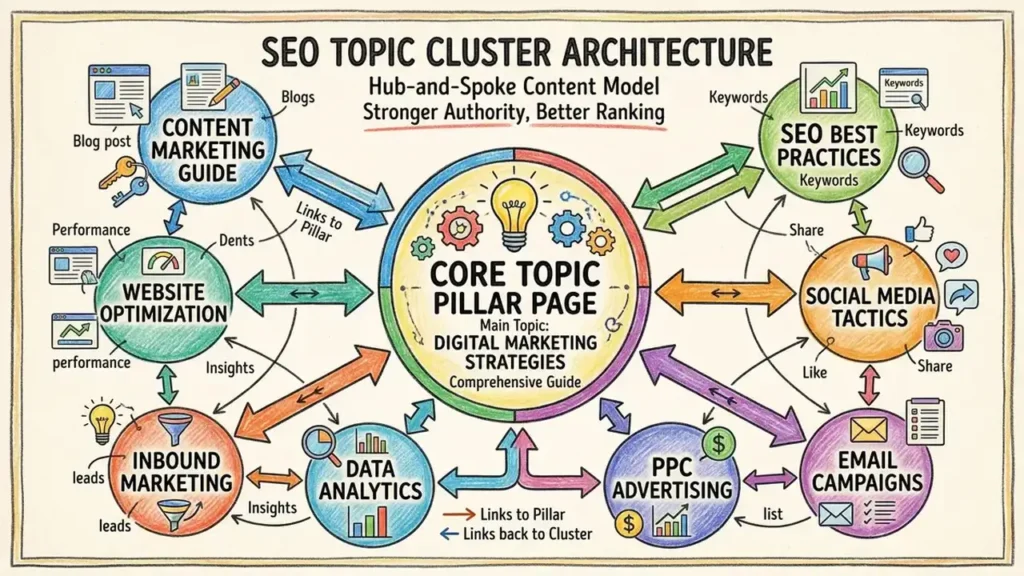
Imagine your site as a well-run bookstore. Each section has a clear theme. Within every section there’s one comprehensive, authoritative book that covers the subject broadly, surrounded by narrower titles that go deep on specific questions. A browser can wander from the general to the specific, and the shop owner can explain exactly why each shelf exists.
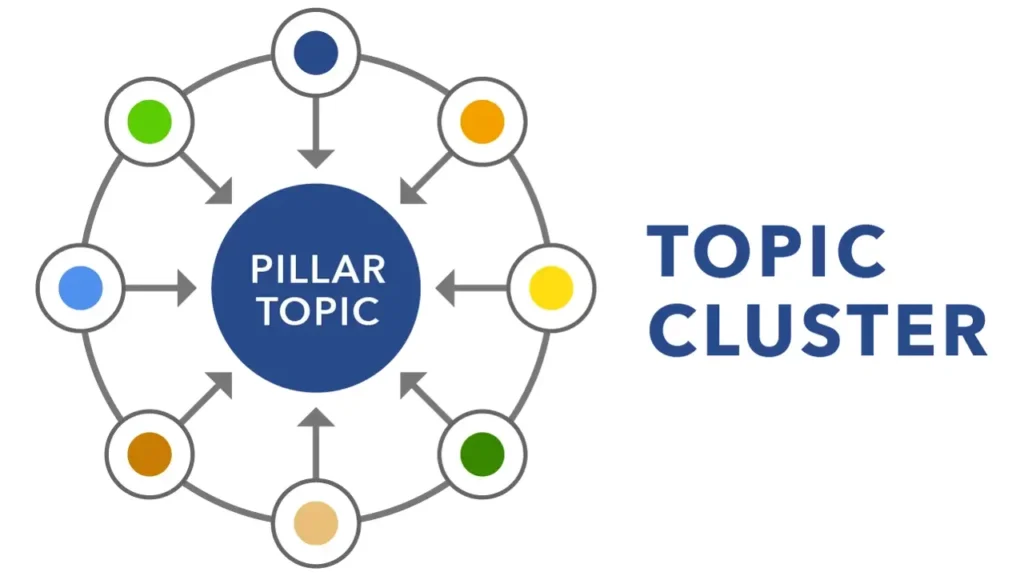
That’s the structure we aim for online, and it comes down to two page types.
Pillar Hubs: The Broad, Authoritative Pages
A pillar page covers a major theme comprehensively. For AI Innovation Hub, that might be a guide to a whole category of AI tools. For AutoChina.Blog, it might be an in-depth overview of a major brand or segment of the electric vehicle market.
A good pillar does three jobs. It answers the broad query thoroughly. It acts as a table of contents for the subject. And it links out to every supporting page in the cluster, passing relevance and helping crawlers discover them.
Sub-Pages: The Specific, Question-Led Articles
Supporting articles tackle narrower questions: a single product review, a head-to-head comparison, a setup guide, a spec breakdown, a “should you buy this” analysis. Each one targets a distinct search intent, and each one links back up to its pillar.
This two-way relationship is the heart of the system. The pillar tells search engines, “these pages are the detailed evidence for my claim of expertise.” The sub-pages tell search engines, “we belong to this larger body of knowledge.” Together, they signal depth rather than randomness.
Internal Linking and Crawl Efficiency
Search engine crawlers have limited time and attention for any given site, especially a new one. If your pages are connected by clear, logical links, crawlers move through your content efficiently, discover new URLs quickly, and understand how pages relate.
If your pages are orphaned or connected only by a vague “recent posts” widget, crawlers have to guess. And guessing is how important articles go unindexed for weeks.
In practice, we follow a few simple rules:
- Every sub-page links to its pillar using descriptive anchor text.
- Every pillar links to all of its sub-pages.
- Related sub-pages link to each other where it genuinely helps the reader.
- No important page sits more than three clicks from the homepage.
- Anchor text describes the destination instead of saying “click here.”
Who This Approach Is For
This isn’t just for tech blogs. The cluster method works for:
- Startup founders who need organic traffic to reduce dependence on paid acquisition.
- Media owners building a niche publication that must look authoritative quickly.
- SaaS companies whose blog should educate prospects and capture search demand around their product category.
- Informational portals that want to be treated as a reference source rather than a content farm.
The mechanics are the same in each case: define themes, build hubs, support them with specific pages, and connect everything deliberately.

SEO Optimization Services
Professional search engine optimization services to boost your website visibility. Keyword research, on-page optimization, technical SEO, and content strategy to drive organic traffic and improve rankings.
- • Keyword Research & Strategy
- • On-Page & Technical SEO
- • Content Optimization
- • Performance Analytics
The Technical Layer: Speed, Code and Markup
Structure gets you halfway. The other half is technical execution, and this is where many young sites quietly sabotage themselves. You can have a flawless content plan and still lose to a competitor simply because your pages load slowly or your code is messy.
WordPress Website Development Done With SEO in Mind
We build on WordPress because it’s flexible, widely understood, and has an enormous ecosystem. But WordPress can be fast or painfully slow depending entirely on how it’s built. Good WordPress website development for an SEO-driven project means resisting the urge to install everything that looks useful.
Our principles are straightforward:
- A lightweight, purpose-built theme rather than a bloated multipurpose one loaded with features you’ll never use.
- A short plugin list. Every plugin adds code, requests and potential conflicts. If a feature can be handled in a template, we handle it there.
- Clean, semantic HTML with a sensible heading hierarchy, so crawlers and assistive tools can parse pages easily.
- Optimized images in modern formats, correctly sized, with descriptive alt text.
- Proper caching and a reliable host so server response times stay low.
- Clean permalinks that reflect the hub structure.
None of this is glamorous. All of it compounds.
Core Web Vitals for SEO: Why Speed Is a Ranking Conversation
When people talk about Core Web Vitals for SEO, they’re talking about measurable signals of real-world page experience: how quickly the main content appears, how fast the page responds to interaction, and whether the layout jumps around while loading.
Why does this matter so much for a new site? Because when two pages answer a query equally well, experience quality can be the tiebreaker. And a young site that’s genuinely fast has an edge over older competitors dragging years of accumulated scripts and ad code.
Here’s how we protect those scores:
- Keep above-the-fold content lightweight, and avoid giant hero sliders.
- Reserve space for images and embeds so nothing shifts as the page loads.
- Defer or remove scripts that don’t serve the reader.
- Self-host fonts where possible and limit font variations.
- Test on mobile first, because that’s where most people arrive and where problems show up fastest.
- Re-check scores after every significant template or plugin change.
Performance isn’t a one-time launch task. It’s maintenance. A single careless plugin update can undo weeks of careful work.
Schema.org Microdata: Helping Machines Understand Your Content
Humans read your article. Algorithms parse it. Schema.org microdata and related structured data formats give those algorithms an explicit explanation of what’s on the page: this is an article, here is the author, here is the publication date, this block is an FAQ, this is a product review, these are breadcrumbs.
Without markup, search engines infer meaning from context, and inference can be wrong. With markup, you remove ambiguity. That clarity can improve how your pages are interpreted and may make them eligible for richer presentation in search results.
On our projects we typically implement:
- Article markup on every post, with author, dates and publisher details.
- Breadcrumb markup that mirrors the hub structure.
- FAQ markup where a page genuinely answers common questions.
- Organization and website markup to establish who is behind the site.
A word of caution: markup must reflect what’s really on the page. Marking up content that isn’t visible, or exaggerating what a page offers, is a fast way to lose trust. Treat structured data as honest labeling, not a trick.
Google AI Updates and Why Young Sites Can Still Win
Search has changed dramatically, and the recent wave of Google AI updates has pushed things further. AI-generated summaries, smarter understanding of intent, and a stronger emphasis on helpful, experience-driven content have all reshaped what ranks.
Two consequences matter for startups.
First, generic content is now much easier to ignore. If your article simply restates what ten other pages already say, there’s little reason for a search system to surface it. Original analysis, genuine experience, clear organization and a distinct point of view carry more weight than ever.
Second, structure and clarity are easier for modern systems to recognize and reward. A site organized into coherent themes, with well-labeled content and fast pages, sends strong signals about reliability and focus. That’s precisely the territory where a new, well-built site can outperform an older, neglected one.
In other words, the playing field hasn’t tilted against new sites. It has tilted against lazy ones.
Winning Organic Traffic in a Competitive Niche
Getting organic traffic in a competitive niche as a newcomer requires a smarter route than head-on confrontation. Here’s the approach we rely on:
- Start with the long tail. Specific, lower-competition questions let you earn rankings and trust before attacking big head terms.
- Build depth before breadth. Fully cover one cluster before opening the next, so you become the obvious specialist in at least one corner.
- Add something original. A hands-on observation, a comparison table, a clear verdict, a practical checklist. Give readers a reason to prefer your page.
- Keep content fresh. In fast-moving topics like AI and electric vehicles, updating articles as facts change is a competitive advantage.
- Match intent precisely. Don’t write a thousand-word essay when the reader needs a quick comparison, and don’t write a thin summary when they need depth.
Over time, authority in a few well-chosen clusters spills over into adjacent topics. That’s how a small site gradually earns the right to compete on bigger queries.
Putting It Into Practice: The First Three Months
Knowing the concepts is one thing; sequencing them is another. Here’s how the early phase looked in practice, and how you can adapt it.
Month One: Foundation and First Clusters
The first month is about groundwork. We finalize the topic map, build the prototype, develop the WordPress templates, configure markup, and test speed. Only then do we publish the first cluster: one pillar page plus its supporting articles, released close together so the hub feels complete rather than half-built.
We also set up analytics and search console tracking from day one. If you don’t capture baseline data early, you can’t tell later what’s working.
Month Two: Expansion and Reinforcement
With the first cluster live and indexed, we watch which pages earn impressions and which queries surface. This informs the next cluster. We also revisit internal links, adding connections between older and newer articles as the library grows.
This is the phase where the discipline pays off. Because every new article already has a home in the structure, adding content is fast and low-risk. Nothing feels improvised.
Month Three: Refinement and Momentum
By the third month, patterns emerge. Some articles outperform expectations; others need rewriting. We improve titles and introductions, strengthen weak sections, add missing FAQs, and fill gaps that the data reveals. New clusters launch, supported by the authority the earlier ones have started to build.
This is also the moment to remind yourself why a properly executed Topic-Cluster Architecture matters so much: it’s what turns a scattered set of articles into a compounding asset, and it’s the reason sustainable organic traffic growth within the first three months is realistic rather than wishful. Without it, you’re publishing into the void and hoping. With it, each new page strengthens the ones around it.
Informational Portal Promotion: Getting the Word Out
A well-built site still needs visibility, and informational portal promotion deserves its own thinking. Organic search is the foundation, but it works best when supported by other channels.
What has worked for us:
- Sharing genuinely useful pieces in relevant communities and social channels, where they add value instead of reading as advertisements.
- Building relationships with people in the niche who might naturally reference good work.
- Repurposing content into short summaries, visuals or newsletters that point back to the full article.
- Maintaining a consistent publishing rhythm so audiences and crawlers learn to expect new material.
- Earning citations the honest way, by publishing original data, clear explanations or analysis worth referencing.
The mistake to avoid is chasing shortcuts. Bulk link schemes and mass-produced filler may feel efficient, but they undermine the exact credibility a new portal is trying to build.
Common Mistakes We See (and Made Ourselves)
Nobody gets this perfect the first time. Here are the pitfalls that come up most often:
- Publishing before planning. Content without a map leads to overlap and cannibalization.
- Overbuilding the tech stack. More plugins and features rarely mean better results.
- Ignoring mobile performance. A site that feels slow on a phone loses readers and rankings.
- Skipping structured data, or implementing it carelessly.
- Spreading too thin. Ten half-finished clusters lose to one thoroughly covered topic.
- Forgetting to update. In fast-moving niches, stale content quietly decays.
- Expecting instant miracles. Early momentum is real, but authority is built over months, not days.
If you avoid even half of these, you’re already ahead of most new projects.
Conclusion: Structure Is the Strategy
Let’s pull the threads together. Launching a content project in 2026 is no longer about who can publish the most. It’s about who can organize, present and maintain their content most intelligently. Start with a clear territory. Plan the architecture alongside the design. Build on a fast, clean WordPress foundation. Mark up your pages honestly. Publish in themed waves. Keep improving what the data tells you to improve.
Our experience with AI Innovation Hub and AutoChina.Blog showed that a new site with no history can earn real search visibility quickly, as long as it’s built on a coherent system rather than good intentions. Everything we’ve covered here, from hubs and sub-pages to speed and markup, comes back to the same foundation: Topic-Cluster Architecture gives young websites the clarity that search engines and readers both reward.
If you’re about to start a project, resist the urge to open a blank document and begin writing. Open a blank map instead. Everything else gets easier from there.

BestChina3DPrinters.com
Your trusted guide to Chinese 3D printers. Expert reviews, comparisons, and recommendations for FDM and resin printers from top brands like Creality, Anycubic, Flashforge, and more.
- • Expert Reviews & Guides
- • Price Comparisons
- • Discount Codes & Deals
- • Beginner-Friendly Tips
Ready to Build Your Site With SEO Built In?
If you’d rather not figure all of this out through trial and error, you don’t have to. We design and build websites with SEO architecture baked in from the first prototype, so your project launches with the structure, speed and markup it needs to start earning traffic quickly.
Order web development with built-in SEO architecture and get your project moving faster: