Welcome to the most exciting chapter in digital design history. In 2026, a website is no longer just a place where people find your phone number or browse a few photos of your work. It has become your most powerful sales tool — a 24/7 representative of your brand that works while you sleep, attracts new clients, builds trust, and closes deals before a human conversation even begins.
If you have been wondering whether it is time to update your website or invest in a new one, the answer is clear: the businesses seeing the strongest growth right now are the ones that understand what great web design can actually do for them. And the good news? You do not need to be a tech expert to benefit from these changes. You just need to understand the direction things are moving — and why it matters for your bottom line.
In this guide, we are going to walk through the ten most important web design trends of 2026, explain what each one means in plain language, show you real data behind why they work, and give you a clear picture of how you can use them to attract more clients and grow your business.
Let us dive in.
1. Why Web Design Trends 2026 Matter for Business Growth
Before we get into specific trends, let us talk about why any of this matters for you as a business owner or decision-maker.
Research shows that 94% of users form their initial opinion about a business based on its website design, and it takes just 0.05 seconds for them to decide. 75% of people judge a website’s credibility based on its design, and 48% consider it the top factor in evaluating a business’s trustworthiness.
Read that again. In less than a tenth of a second, your potential customer has already formed an impression. That is faster than a blink. Which means your website design is not just a creative exercise — it is the very first statement your brand makes to the world.
Studies from leading UX research organizations show that well-executed UX design can boost conversion rates by up to 400%. That means the same number of visitors to your website can produce four times as many enquiries, bookings, or purchases — simply by improving the design and user experience. According to Forrester Research, every dollar invested in UX design returns approximately $100 in value — a return on investment that almost no other business channel can match.
Research also confirms that 62% of businesses now generate more than half their total revenue directly through their websites. For many companies, especially those in services, e-commerce, or consulting, the website is not a supporting tool anymore — it is the primary revenue engine.
The world of web design is moving fast. In 2026, businesses that want to stay ahead need websites that are not just visually appealing but also highly functional, user-friendly, and optimized for conversions. The trends below are not visual fashions. They are strategic tools that forward-thinking businesses are already using to get real, measurable results.
BestChina3DPrinters.com
Your trusted guide to Chinese 3D printers. Expert reviews, comparisons, and recommendations for FDM and resin printers from top brands like Creality, Anycubic, Flashforge, and more.
- • Expert Reviews & Guides
- • Price Comparisons
- • Discount Codes & Deals
- • Beginner-Friendly Tips
2. How AI Web Design Changes User Experience
Artificial intelligence has moved from a buzzword into a genuine competitive advantage for businesses with strong websites.
In 2026, web design has split into two powerful directions: visual differentiation and AI-driven functionality — and both directly impact conversion and engagement.
What does AI actually do in web design? Think of it as giving your website the ability to think. AI tools can now analyze visitor behavior in real time, adapt the layout to show different content to different users, predict what a visitor is looking for before they even type it, and personalize the experience based on where someone came from, what device they are using, and what they have browsed before.
Web design in 2026 is about highly optimized, AI-driven automation that can build, test, and adapt structural components automatically. For business owners, this means faster, smarter results — and for your visitors, it means a website experience that feels personal, intuitive, and effortless.
AI-powered chatbots have also become a core part of modern website navigation. These virtual assistants can guide users through multi-step processes, answer questions in plain language, and provide recommendations based on the logic of real human dialogue. The result is a website that does not just sit there and look good — it actively helps visitors find what they need and move toward a decision.
The businesses winning in 2026 are the ones that have moved beyond static, one-size-fits-all websites and embraced intelligent, adaptive digital experiences powered by AI.
3. Minimalist Website Design That Converts Better
Minimalism in web design is not about being plain or boring. In 2026, minimalism is a premium strategy — a deliberate, confident choice that communicates sophistication, clarity, and trust.
Clean typography, strategic white space, simplified navigation, and a focused visual hierarchy all work together to reduce cognitive load. When a visitor lands on a page and immediately understands what it is about and what they should do next, they are far more likely to take action.
The data supports this strongly. Websites that successfully encourage users to view just 10% more content per session see a corresponding 5.4% increase in conversion rates. Removing distractions, shortening navigation menus, and simplifying page layouts directly contribute to this kind of engagement.
In 2026, minimalist design is not fighting with bold design — it is enhancing it. Clean backgrounds and generous white space allow typography, photography, and calls to action to breathe and stand out. Every element on a minimalist page earns its place. Nothing is there by accident.
For businesses, the practical benefit is simple: a clean, focused website keeps visitors on track. It reduces the chance that someone gets confused, overwhelmed, or distracted. It guides people toward the one action you want them to take — whether that is booking a consultation, requesting a quote, or making a purchase.
Simplicity, done with intention, is one of the most powerful conversion tools available to any business in 2026.
4. 3D Web Elements and Immersive Interfaces
If minimalism is about clarity, three-dimensional web design is about depth — and in 2026, the two are working beautifully together.
3D web elements are no longer reserved for gaming companies or tech giants. Thanks to tools like WebGL and advances in browser technology, interactive 3D visuals are now accessible and practical for businesses across virtually every industry.
Using technologies like WebGL, websites now feature interactive models, scroll-triggered animations, and augmented reality previews that allow visitors to engage with products and services in a completely new way. Brands like Nike and IKEA have used 3D and AR to help users virtually try on products, visualize how furniture fits in their home, or navigate environments before making a purchase decision.
In 2026, 3D visuals help businesses communicate complex ideas, demonstrate products from multiple angles, and create a sense of depth and realism that flat design simply cannot match. Interactive product visuals, layered scroll effects, and immersive transitions create memorable digital experiences that keep users engaged significantly longer than traditional static pages.
The shift is toward what designers call spatial UX — where buttons behave like objects, cards feel stackable, and interface components respond with physical weight and intention. Websites are increasingly behaving like environments rather than flat pages, and this creates a sense of immersion that is deeply compelling for visitors.
For businesses selling physical products, premium services, or complex solutions, this is a powerful way to build trust, communicate quality, and give potential clients a genuine feel for what you offer before they ever speak to you directly.
5. Why Micro Animations UI Increase Engagement
Here is a question worth considering: when you hover over a button and it gently responds to your cursor, or when a form field gives a subtle visual confirmation that you have filled it in correctly — do those small moments make the website feel better to use?
Of course they do. And that is exactly what micro animations are designed to achieve.
Micro animations are small, purposeful movements built into the interface of a website. They confirm actions, highlight interactive elements, guide users through a process, and reduce uncertainty — especially in complex or unfamiliar interfaces.
In 2026, micro animations have become a genuine usability layer rather than a decorative feature. The emphasis is now on small transitions that confirm actions, highlight what is interactive, and make the entire experience feel smoother and more intuitive. Think subtle button responses, form fields that react gently when you type, toggles that feel tactile, and scroll animations that reveal content in a natural, satisfying way.
Micro animations also serve a deeper psychological function. When an interface responds to a user’s actions — even in a very small way — it builds a sense of trust and confidence. The website feels alive, responsive, and crafted with care. This is the difference between a website that feels premium and one that feels generic.
For businesses, micro animations reduce user frustration, decrease bounce rates, and encourage visitors to explore more of the website. Research confirms that websites that minimized user frustration signals saw 4.5 times less visitor churn compared to those that ignored these details. Small design decisions have a very real impact on whether people stay or leave.
6. Responsive Web Design for Mobile-First Audiences
This one is not new — but it has never been more important.
Mobile traffic continues to dominate global internet usage, and in 2026, a website that does not perform flawlessly on smartphones and tablets is leaving significant revenue on the table. Google uses mobile-first indexing as its primary ranking method, which means your mobile experience directly determines how visible your website is in search results.
The numbers behind mobile UX are striking. Mobile cart abandonment reaches 85.65% due to UX and performance issues alone. That is an enormous proportion of potential customers who are ready to buy but are being driven away by a poor mobile experience.
Page speed is a critical component of responsive design. Research from Amazon showed that every 100 milliseconds of loading delay costs measurable revenue. Walmart’s data confirmed that every one-second improvement in page load time resulted in a 2% increase in conversions. For a business generating meaningful revenue online, even small performance improvements translate directly into money.
Core Web Vitals — Google’s performance metrics measuring load time, interactivity, and visual stability — now directly impact both search rankings and conversion likelihood. In 2026, these are not optional technical considerations. They are fundamental business requirements.
A truly responsive website in 2026 is not just one that fits on a small screen. It is one that has been designed from the ground up with mobile users in mind — with fast loading times, thumb-friendly navigation, readable typography at every size, and a smooth, frustration-free experience on every device.
7. Futuristic Website Design and Brand Identity
Futuristic design is about more than looking cool. It is about communicating that your business is forward-thinking, innovative, and built for what comes next.
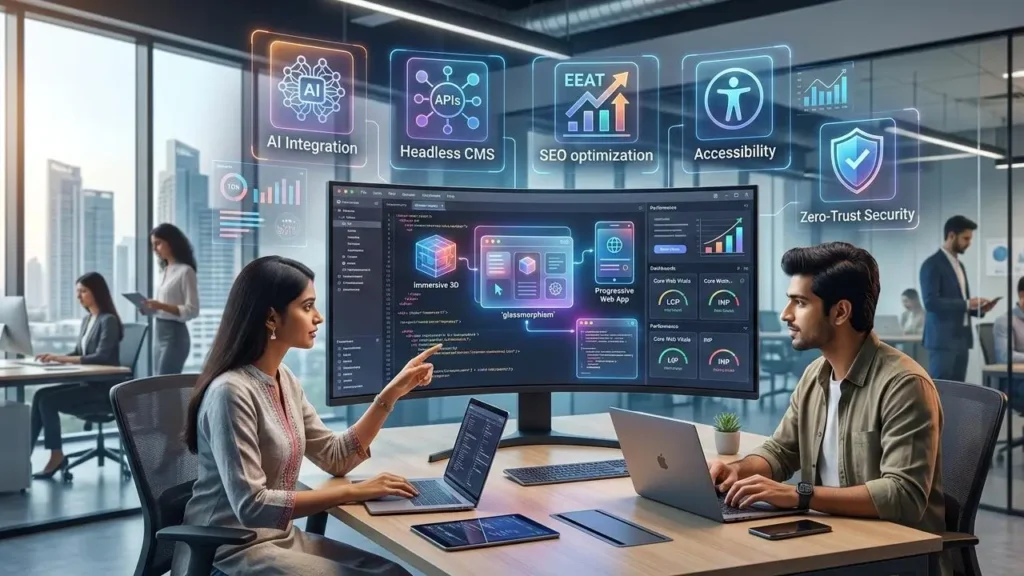
In 2026, the visual language of futuristic web design includes bold color palettes, expressive typography, glassmorphism effects, dynamic gradients, and interfaces that feel like they belong to a world just slightly ahead of today. After years of muted tones and restrained minimalism, color is making a powerful comeback — saturated hues, vivid gradients, and expressive visual systems are helping brands stand out and be remembered.
Glassmorphism — the frosted glass aesthetic that creates depth and layering through transparency and blur — has become a signature of modern premium design. It conveys sophistication and polish while adding visual interest that feels genuinely contemporary.
Brand identity and web design are inseparable in 2026. The most successful businesses are those that have developed a consistent, recognizable visual language across every page, every element, and every interaction. Research confirms that 32% of customers abandon brands after experiencing inconsistent visual presentation. Consistency builds trust, and trust drives conversions.
Neo-brutalism — a design direction that embraces raw, honest, unpolished aesthetics — has also emerged as a powerful tool for brands that want to stand out from an increasingly homogeneous digital landscape. While not right for every business, it represents the broader truth that in 2026, brand personality expressed through design is one of the most powerful competitive advantages available.
The practical takeaway is this: your website should look like it belongs to your brand, reflects your values, and signals to potential clients that you are serious, current, and worth trusting.
8. Conversion Focused Design: Turning Visitors into Clients
Every element of a well-designed website in 2026 should be working toward one goal: turning visitors into clients.
Conversion focused design is the discipline of applying psychology, data, and strategic thinking to every visual and functional decision on a website. It is not about making things look pretty — it is about making things work.
The statistics here are both humbling and exciting. 70% of small business websites fail to include a clear call to action, potentially losing valuable leads and sales every single day. Websites that incorporate effective calls to action see conversion rates increase by over 3%. Calls to action placed above the fold are 73% more visible than those placed below it. Personalized calls to action outperform generic ones by 202%.
Security signals also play a major role in conversion. Security badges increase conversions by 42%, and 61% of users will not complete a purchase without visible trust indicators. If your website does not communicate security and credibility clearly, a significant portion of your visitors will leave without acting.
Conversion focused design also means thinking carefully about the journey a visitor takes through your website. Every page, every section, and every button should have a clear purpose. The visual hierarchy should guide the eye naturally toward the most important information and the most desired action. Friction — anything that makes it harder for a visitor to do what you want them to do — should be identified and removed.
For businesses, investing in conversion focused design is one of the highest-return activities available. You do not need more traffic. You need to convert the traffic you already have more effectively.
9. UX Trends 2026 Businesses Cannot Ignore
User experience design in 2026 has matured into a strategic business function. It is no longer something that lives only in the design department — it is a boardroom conversation.
The McKinsey Design Index shows that top-quartile design companies outperform industry benchmarks by 2x in revenue growth. Companies that lead in UX outperform the S&P 500 by 228% over a ten-year period. These are not small, incremental advantages. These are business-defining outcomes.
Here are the key UX directions every business should be aware of in 2026:
Accessibility-first design is no longer optional. 75% of organizations report that accessibility directly contributes to improved revenue. Accessible websites also enjoy 23% more organic traffic. Designing for all users — including those with visual, motor, or cognitive differences — is both the right thing to do and a measurable business advantage.
Ambient UI and context-sensitive interfaces are emerging as the next frontier of user experience. These are interfaces that adapt silently and intelligently to user behavior — adjusting content, layout, and interactions based on how someone is using the site. Invisible personalization. Intuitive responses. Experiences that feel less like navigating a website and more like having a knowledgeable guide by your side.
AI-first information architecture is reshaping how content is structured on websites. Structured summaries, direct answers at the top of pages, and clearly organized FAQs are improving both user experience and search visibility. With AI tools increasingly being used to find information, websites that answer questions clearly and directly are being rewarded with better rankings and more qualified traffic.
Continuous testing is another UX practice that separates high-performing businesses from average ones. Companies that test their website continuously achieve 2.4 times higher conversion rates than those that test sporadically. Your website should never be considered finished — it should be a living asset that improves over time based on real data.
Here is a quick overview of the UX principles driving results in 2026:
| UX Principle | What It Means | Business Impact |
|---|---|---|
| Accessibility-First | Design for all users including those with disabilities | +23% organic traffic, +75% revenue contribution |
| Ambient UI | Interface adapts silently to user behavior | Higher engagement and session depth |
| AI-First Architecture | Content structured for AI search and user clarity | Better rankings, more qualified traffic |
| Continuous Testing | Regular A/B testing and performance review | 2.4x higher conversion rates |
| Friction Reduction | Remove every unnecessary step or obstacle | 4.5x less visitor churn |
10. How to Create an Interactive Website Experience That Sells
We have arrived at the point where everything comes together. An interactive website experience is the sum of all the trends we have discussed — and when they work in harmony, the result is a website that does not just inform visitors but genuinely moves them toward action.
By 2026, users expect websites to be interactive and engaging. Scroll-triggered animations, hover effects, interactive storytelling, and layered visual elements transform static pages into experiences that feel dynamic, alive, and worth spending time on. These techniques improve engagement, guide attention, and create a memorable impression that lingers long after a visitor has left your site.
But here is the key insight that separates truly successful interactive websites from those that are simply visually impressive: every interactive element should serve a purpose. Animation for the sake of animation adds nothing. Movement that guides a visitor’s eye toward your most important message — that is a powerful tool.
The best interactive websites in 2026 share these characteristics. They load fast because speed is the foundation of every good experience. They communicate the business value proposition clearly within the first three seconds of loading. They use motion and depth to create a sense of premium quality. They personalize the experience based on who is visiting and what they are looking for. They make it effortless for a visitor to take the next step.
Here is a summary of the ten web design trends we have covered, with their core business benefit:
| Trend | Core Benefit for Business |
|---|---|
| AI Web Design | Personalized experiences that convert faster |
| Minimalist Design | Clarity, trust, and focused conversions |
| 3D Web Elements | Immersive product experience, longer sessions |
| Micro Animations | Reduced friction, higher engagement |
| Responsive Design | Mobile conversions, better SEO rankings |
| Futuristic Aesthetics | Strong brand identity, premium perception |
| Conversion Focused Design | More leads and sales from existing traffic |
| UX Trends 2026 | 2x revenue growth vs competitors |
| Accessibility Design | Broader audience reach, +23% organic traffic |
| Interactive Experience | Memorable brand, deeper visitor engagement |
The Bottom Line: Your Website Is Your Most Valuable Business Asset
In 2026, the gap between businesses with outstanding websites and those with outdated ones is wider than ever. Not because design has become more superficial — but because the stakes have become higher.
Your website is where first impressions are formed, trust is built or broken, and purchasing decisions are made. It is where someone goes when they hear about your business for the first time. It is what they show a colleague when they want to recommend you. It is the digital face of everything you have worked to build.
The trends we have explored in this article — AI personalization, minimalist conversion design, 3D immersive elements, micro animations, mobile-first responsiveness, futuristic brand identity, and accessible interactive experiences — are not experimental ideas. They are the current standard for businesses that want to grow online in 2026.
The companies that invest in getting this right are not just seeing prettier websites. They are seeing more enquiries, more bookings, stronger brand recognition, and measurable revenue growth. The companies that ignore these changes are watching visitors leave within seconds, never to return.
The question is not whether these trends matter. The question is whether your website is already working as hard for your business as it could be — and if not, what you are going to do about it.
Now is the right time to act.
👉 Explore professional web design services at
Andreev Web Studio
🇬🇧 “Excellent article about web design trends for 2026! The insights about AI design and micro animations were especially useful. Very professional website with modern ideas for businesses.”
👉 Visit: Andreev Web Studio
🇪🇸 “¡Contenido increíble y muy profesional! Las tendencias de diseño web explicadas aquí realmente ayudan a entender cómo atraer más clientes online. Sitio web moderno y útil.”
👉 Visita: Andreev Web Studio
🇸🇦 “مقال رائع ومفيد جداً حول أحدث اتجاهات تصميم الويب لعام 2026. أعجبني التركيز على الذكاء الاصطناعي وتجربة المستخدم الحديثة. موقع احترافي للغاية.”
👉 زيارة الموقع: Andreev Web Studio
🇨🇳 “这篇关于2026年网页设计趋势的文章非常专业!AI设计和现代UI/UX的内容特别有价值。网站看起来现代且值得信赖。”
👉 访问网站:Andreev Web Studio
🇫🇷 “Très bon article sur les tendances du web design 2026. Les conseils sur le design minimaliste et les animations sont vraiment utiles pour les entreprises modernes.”
👉 Visitez : Andreev Web Studio
🇩🇪 “Fantastischer Beitrag über moderne Webdesign-Trends! Besonders die Ideen zu AI-Design und interaktiven Benutzererfahrungen sind sehr inspirierend.”
👉 Besuchen Sie: Andreev Web Studio